
Some people are haunted by ghosts, others are haunted by a sense of meaninglessness in a vast, expanding universe; but me? I’m haunted by food.
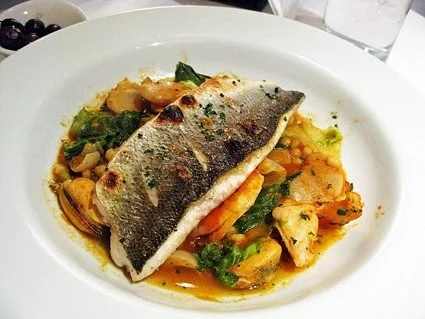
Restaurant dishes, dishes I make I home: it doesn’t matter. I crave them, I want them. Lately, I’ve been haunted by a dish I ate two weeks ago with my friend Lauren who kindly agreed to cat-sit for me when I was in Seattle. As a reward for her cat-sitting, I took her to The Union Square Cafe for lunch and it was there that I encountered the dish that’d haunt me for weeks to come: the cacciucco you see in the picture above.
Let’s start with pronunciation: according to Wikipedia, Cacciucco is pronounced: “/katʃuk:o/” Wait, say WHAT Wikipedia? There’s a “t” sound in a word with no “t”? You must jest. Italian readers, tell me Wikipedia is jesting.
The waitress clearly didn’t think Wikipedia was jesting, she corrected me when I ordered it from the menu; I pronounced it “CATCHY UCCO.” She instantly corrected me–she had a haughty Austrian accent and an off-putting aggressive personality–so I felt thoroughly chastised. I still can’t remember, though, if she pronounced it with a “t.”
Anyway, Cacciucco is a fish stew that comes from Livorno. It’s cooked with wine, tomatoes and chiles and that alone should make you crave it. But what I loved about The Union Square Cafe’s version was how artfully it was put together.
The menu describes it as: “Cacciucco of Branzino, Mussels, Octopus and Shrimp with Fregola, Gigante Beans and Cappezzana Olive Oil.” (Did I ever tell you about the time I ate dinner with a daughter of the Cappezzana Olive Oil estate? I didn’t? Maybe some other time!)
I imagined a robust stew with shells and eyes and fins and all the gunk you normally see in a fish stew (well it depends where you are). Here, everything was done for you: the mussels were out of their shell, the shrimp was out of its shell, the branzino was seared so the skin was crispy and laid on top.
More importantly, though–almost like a great pasta dish–all of these elements were unified by both the flavor (the wine, the tomatoes, the spice) and the other textures involved: the beans (which balanced the meatiness of the fish), the fregola (which gave more of a bite and absorbed the sauce) and some kind of greens that were also thrown in that gave the dish depth and color.
In many ways, and I think you might agree just looking at the picture, this dish is a mini-masterpiece. It’s also one of the most expensive dishes on the lunch menu at $26; but if you’re splurging anyway, and you’re craving something hardy yet light enough that you won’t feel weighed down the rest of the day: this is your dish.
Bravo to the Union Square Cafe for making a Cacciucco fan out of me: now if I could only say it, all would be well.





Comments
20 responses to “Cacciucco at The Union Square Cafe”
If I’m remembering my Italian pronunciation correctly, there is a harsh c sound, which could sound like a t. The pronunciation of the c is determined by what consonants and vowels it is linked with. A c followed by an i will always be a ‘chh’ sound, but a c followed by a consonant will always be a harsh c, making the ‘k’ sound. Since you have a word with two cs followed by an i, the first c will make a ‘k’ sound, followed quickly by a ‘chh’ sound. Phonetically, I would describe it as ka/k/chu/cho, but I can see why you would use a t instead of a k, because it makes a similar sound.Hmm. I hope that made sense. I’m not a linguistics expert by any means. Long story short, there is a t sound in there. Also, the soup looks nothing short of delicious. I lived in Tuscany for a while, and this brings back good memories of going to the beaches near Piza. A fabulous area of Italy.
I think wikipedia is trying to tell you to say cat-CHEW-ko. The double C in front of an I means a very hard “ch” sound, which I guess they are representing with a t… but basically you want to avoid cashew-co and you’ll be fine!PS, Happy Blog Birthday 🙂
Similar to Chicken Cacciatore, also with no “t” but it sounds like a “t”.
What Wiki is trying to say by using /tʃ/ is that it’s pronounced exactly like the first sound in “chocolate”. /tʃ/ is a digraph used in phonetics to express just this sound, i.e. voiceless postalveolar affricate… ;)Warm regards from snowy Poland!
Bravo, Piotrek! Or like in “Kaczyński”!?
However you say it, the dish looks great!
However you say it, it does look good.I too, share your tendency towards “culinary hauntings”. I once had the perfect deviled egg at an upscale BBQ joint (kind of an oxymoron!) in Texas. I tried to recreate it for months!
What is surprising to me is a waitress at Union Sq treating you haughtily. Danny Meyer’s service is usually exemplary and he’s famous for it.
What is surprising to me is a waitress at Union Sq treating you haughtily. Danny Meyer’s service is usually exemplary and he’s famous for it.
What is surprising to me is a waitress at Union Sq treating you haughtily. Danny Meyer’s service is usually exemplary and he’s famous for it.
Yes, basically it’s pronounced “catCHOOko.” We really don’t pronounce the t in catch in English, anyway…at least I don’t…That hard ch sound is common in Italian words…caccio (cheese), caccia (hunt), braccio/a (arm(s)), faccia (face), minaccia (threat)….all pronounced similarly.
Exactly the way we pronounce the “cc” in the word cappuccino. I´m not sure it is pronounced the same way in America though.
this is probably repeating what was said above, but it’s cah-CHOO-koh (note the soft o to close). there’s no t sound and you don’t have to hold the double c for overlong. the double c is soft preceding an i, but hard when preceding an o. now you’re an italian.
this is probably repeating what was said above, but it’s cah-CHOO-koh (note the soft o to close). there’s no t sound and you don’t have to hold the double c for overlong. the double c is soft preceding an i, but hard when preceding an o. now you’re an italian.
this is probably repeating what was said above, but it’s cah-CHOO-koh (note the soft o to close). there’s no t sound and you don’t have to hold the double c for overlong. the double c is soft preceding an i, but hard when preceding an o. now you’re an italian.
this is probably repeating what was said above, but it’s cah-CHOO-koh (note the soft o to close). there’s no t sound and you don’t have to hold the double c for overlong. the double c is soft preceding an i, but hard when preceding an o. now you’re an italian.
like adrienne, suzanne and tom said…the ‘t’ sound comes from the double ‘c’–consider it like the ‘t’ sound that comes from the double ‘z’ in “pizza.”additionally, whenever there’s an ‘i’ or ‘e’ following a ‘c’ or ‘z’ in italian, it generally serves just to change the function of the preceding consonant. thus, you say not, “catchY…” but “cat-choo…”boring? a little, but now you can squelch those cravings without the austrian glare 😉
“Restaurant dishes, dishes I make I home.” Adam, did you really mean to say this? I love the post, but didn’t you really mean to say “at home” or something else?
I totally know what you mean being haunted by dishes, I get that way with curries! That looks transcendent! I want to cat sit for you so that I can eat such lovely food:)Hehe!
Oooooh, Adam….my boyfriend makes the most AMAZING cacciuccio….he finishes it off with a big dollop of creme fraiche and serves it with lots of crusty white bread to soak up the juices. Utterly fabulous.You have a standing invitation to come and try it when you’re next in Australia.